
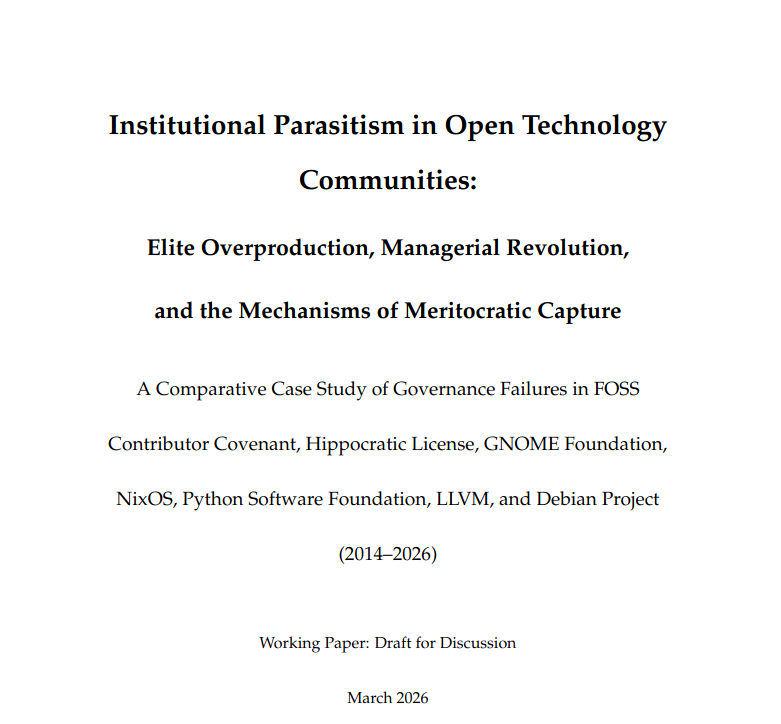
Institutional Parasitism in Open Technology Communities: 79-page paper on how people who can't code took over the projects built by people who can
paper.png

Institutional Parasitism in Open Technology.pdf

lain9.jpg
Debian 2026 DPL election. One candidate. Diversity platform. Nobody else showed up. That's where the oldest community distro is now.
GNOME hired a literal shaman who sold flavored water as Executive Director. Harvard degree, zero commits. Nine months later she quit and they started firing people. The guy who invented Timsort, the sorting algorithm inside Python and Java and Android, got suspended three months for saying CoC enforcement could ruin careers. LLVM lost 4,344 commits worth of contributor because he wouldn't sign a code of conduct. NixOS founder pushed out by a petition, then the moderators who replaced him resigned too.
Ehmke claims $750K raised for her ethical source nonprofit. Open Collective shows $8,451. Her CV lists an Omidyar Group exec as personal reference. Same Omidyar that funds her org and picked her as a Luminary. The paper maps every node in the funding network.
GitHub ran their open source survey in 2017 and 2024. In between 100K+ projects adopted codes of conduct. Every measured category of harassment went up. Every single one.
22 theoretical frameworks including peer-reviewed studies showing narcissistic grandiosity correlates with progressive activism (r=0.19-0.21) while genuine altruism shows zero correlation. Bioleninism explaining why governance coalitions are so cohesive. Graeber's bullshit jobs taxonomy mapping perfectly onto Community Manager and DEI Director positions. Full counter-strategy playbook. Predictions through 2030 covering EU CRA, UK Online Safety Act, and AI-automated CoC enforcement.
Excellent paper. I have one comment for the authors if they happen to be reading this thread.
The alternative hypotheses were dispensed with satisfactorily, but a key one was unmentioned. It could be said that widespread adoption of Code of Conducts have made people more conscious of interpersonal problems, more willing to speak up about them, thus the CoC fulfils it's stated goal by making people feel more able to expose ‘bad behavior' and facilitates remedial action. I don't believe that myself, yet this is a valid alternative explanation that ought to be dispensed with in the paper, because it is an especially important point.
The alternative hypotheses were dispensed with satisfactorily, but a key one was unmentioned. It could be said that widespread adoption of Code of Conducts have made people more conscious of interpersonal problems, more willing to speak up about them, thus the CoC fulfils it's stated goal by making people feel more able to expose ‘bad behavior' and facilitates remedial action. I don't believe that myself, yet this is a valid alternative explanation that ought to be dispensed with in the paper, because it is an especially important point.
I want to draw attention to this flaw because I know 100% that craftier cunts than I will see this and jump on it. They can throw in a slogan like "correlation is not causation" and appeal to the ego of the casual reader, butter them up with 'smart slogans'. You know how everyone and their mother won't shut up about the Dunning-Kruger, because they think it's not about them? Like a less potent version of that.