I now understand why some people want absolute control over their computers [rss]

Aza >30d ago #p18094 >>quote
templeos box.png
templeos box.png
I used to think, “Haha, lol, imagine spending 100 hours just to get a working system,” but I have been using Linux Mint for a long time, and I'm just getting so damn tired.

Age verification is rolling in; my PC is a ThinkPad, and it is not built different, so I can't even use Gentoo, and I might use BSD, but I'm not sure since I rely on Wi-Fi. Linux is becoming a botnet and is going to become the next Windows in the foreseeable future. Hell, if everything wasn't online, I would just put TempleOS on the PC and do my actual work in real life like a normal human being.

I would go the full DIY route, but I am hesitant. My hardware isn't meant for heavy compiling, so Gentoo is out. Arch might be an option, but I worry it will eventually bow down to age verification and tracking. Does anybody actually even use LFS?

Is it over? Will we all switch to BSD? What after BSD? I just want to use my system and not worry about glowies putting shit in it every second. My plan right now is to probably drag my PC across the room, plug into Ethernet, and try installing OpenBSD. If that doesn't work, I might just cry myself to sleep. Can you anons help me out? I genuinely just want to get away from all of this.
Attachments:
templeos box.png (75.55 KB)
Replies: >>18195 >>18239 >>18249
Anonymous >30d ago #p18097 >>quote
I think you're going to have a far easier time till that day were to so ever happen on every distro simply just sticking to linux. If you're using Linux right now, you're saving documents doing whatever then say if that distro is forced age verification you can just pull all your files off and switch to a distro without it. There is no point making your life harder than it needs to be simply for a day that may or may not happen on your particular distro.
If you're looking for a distro to use I'd recommend either using Artix or Void (musl variant preferred ) reasons being the removal of systemd and having a solid distro with packages.
Anonymous >30d ago #p18195 >>quote
>>18094

switch to a distro that won't add verification then
void is a good one
geist >30d ago #p18196 >>quote
>Is it over?
No
>Will we all switch to BSD?
Yes
>What after BSD?
More BSD

I don't understand why you don't just go and check if your network card is supported. FreeBSD and OpenBSD are both excellent choices
Anonymous >30d ago #p18220 >>quote
>Gentoo
Gentoo has binary packages so you can skip compiling heavy stuff like firefox libreoffice and webkit. Personall, after trying gentoo I can't stand other distros anymore. I usually use a wm so I already have to diy a fair bit of stuff and it's easier to then just diy everything instead of constantly fighting against distro maintainers' picks (offline-updates in fedora, snap, systemd, turning off services I don't use, repo doesn't have a program I use so I have to compile it anyway, etc...
Replies: >>18239
Anonymous >30d ago #p18239 >>quote
>>18220
Gentoo is a dying corpse, just like Debian. It is infiltrated by fucking retards and corposhit bootlickers.
I checked it out recently and it is in far worse shape than it was in 2021. You can't build an initramfs without pulling absurd amounts of shit you didn't need. I was able to build initramfs easily without dracut and numerous amounts of packages I don't need. Now it's just a hard dependency, and it's nearly impossible to build initramfs without dracut.
They're also dropping eudev and pulling more dependencies from systemd, also making those a hard requirements, also OpenRC maintainer is a huge retard and a faggot, that is just ruining the project. Can't wait until the OpenRC will require half of the systemd garbage just to work properly. Also you won't be able to have separate /usr soon, but you don't need it, do you?
Compare Gentoo to FreeBSD with poudriere and you will see how much garbage Portage is. poudriere is more simple, actually maintainable, the code is not spagetty python shit, and it is just more powerful and effective.
>>18094
I hate how we came to this state where we don't own our computers. Like, yeah, they're physically there, and you can install operating system that is free and the source is open, but can you understand what is happening behind the scenes? Most people use distros with systemd and GNU utilities, that are millions of lines of code, but can you actually study the code, that is purposely bloated so that the vendor (RedHat) has more control over the software you use? Both GCC and Linux require GIGABYTES of storage just to download them, and even more if you wish to actually build them. This is called bloat monopoly, when the software that begins somewhat small and insignificant grows into millions and millions of lines that no one could understand. And if no one could understand how it works, it grows even more, just slapped on top instead of redoing some parts and improving the software. Then capitalist corporations get involved, hire countless of people, hijack the source code and WONTFIX patches or improvements. The examples are obvious, GNOME, GTK, systemd, Linux, Xorg, Wayland they're all hijacked by RedHat faggots to take away your freedoms, by creating software that is both unportable and impossible to understand. The design is purposely complicated because it's made by illiterate retards on payroll to build a walled garden so you can't control your computer.
Have you ever tried wiritng graphical application for Wayland? Or for Linux DRM? Believe me, it's so horrible that you will beg to be shot just not to touch this shit again in your life. Same for the sound system. And, honestly, for everything else.

Linux (and Unix) in general is made on deprecated 1970 concepts, that were good back then for what they were: providing access to one mainframe with multiple terminals and time-sharing. Now you don't need that for your computer, but you have no choice. Hardware access is unclear and obfuscated, realistically speaking only the vendor can design the drivers for the video card, that is essential for basic interaction with a computer. Yes, VESA modes exist, but they're limited to couple of resolutions and that's it.

Terry was unironically right, most people just don't seem to understand what he was trying to make. He wanted to bring Commodore 64's simplicity to the modern world. He made sure that TempleOS runs at Ring 0, has no memory protection, no preemptive multitasking with complicated scheduling, clearly designed and has everything for you to have fun using a computer. He created graphics libraries and programming language that is part of the operating system (and the shell), instead of being slapped on top. He created hyperlinked rich text format, so that you're not limited by plain text. He was forward thinking, he wanted to bring the joy of computing back.

You didn't understand TempleOS. No one really did. Unfortunately, it is mostly seen as the "schizo" creation, and by that shallow judgement people miss what actually is a TempleOS. It is a Commodore 64, with no "shiny things", and no limits. No one is trying to hold you back by obfuscating and hiding your computer's resources under layers of abstraction, without giving you the ability to bypass those abstractions. No one's setting a permissons on which files you can and cannot open, see or write. It has no sudo, no root. Only 640x480, TUI, and no usermode, as God intended. TempleOS had it's own flaws, but Terry wasn't no Operating System researcher. He was just a regular guy with a computer. A regular guy that wanted to make computing fun again. A regular guy, who was mentally ill, who was struggling, but still was stubborn enough to build his own operating system, programming language, and a compiler. That's why he is forever a hero.
Replies: >>18244
Anonymous >30d ago #p18244 >>quote
1774793798709708.png
1776131967278941.png
>>18239
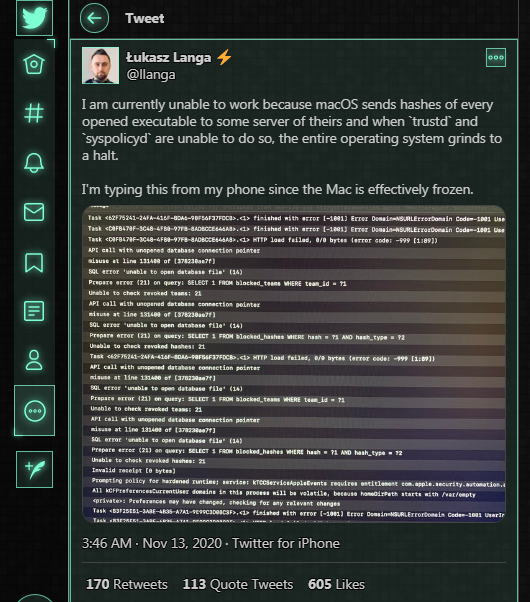
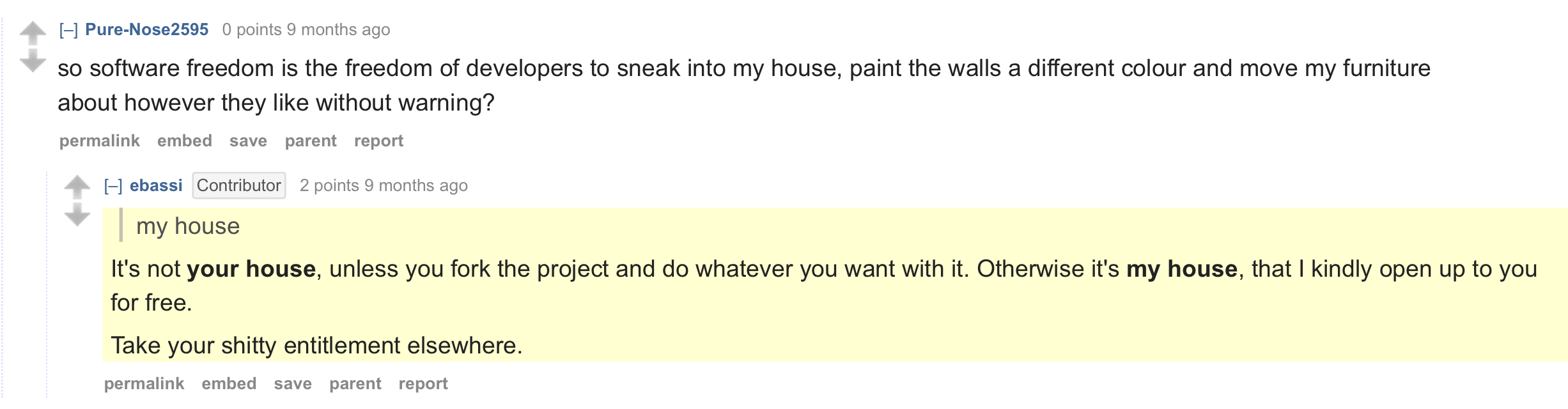
Also a friendly reminder that this is not *your* computer in any way, it is *their* computer, until you have the ability to understand and change the source code. But good luck changing anything in 1M+ codebase with poor or nonexistent documentation, or even worse, in hostile closed source software. You're not a master of your machine, but just a servant. The software made by large corporations just mercifuly permits you to use your computer, while trying to extract as much profit (in case of Windows), or lock down with bloat monopoly until they figure out how to suck money from you (in case RedHat, Oracle, Intel, and other large corporations that are contributing to Linux). Like in systemd our homosexual vibecode retard magician Harry Poettering silently merged age verification into the codebase while actively preventing actual discussion about how and whether even it should be done. Oh, you know, systemd is already in just every single Linux distribution. So deal with it. It's not your house. Fuck you. Suck IBM's cock or be left behind. Somebody else here at Cyberix did a thread about how linux is compromised. Look it up.
Attachments:
1774793798709708.png (365.31 KB)
1776131967278941.png (132.92 KB)
Anonymous >30d ago #p18249 >>quote
>>18094
At this point I think that if you really want as close to "complete control" as possible while sticking with linux and avoiding any and all of the current enshitification to an almost militant level, your only option is Hyperbola. Just take a look at this if you aren't aware of their stance on things: https://wiki.hyperbola.info/doku.php?id=en:philosophy:incompatible_packages. There is zero chance of them doing anything with age verification. Its really the only thing out there which can provide a foundation that you can work with in both the immediate and long term without worrying about some variation of poison creeping in at any point. Outside of that OpenBSD .

[ reply ]